Table of Contents
- Why Balance and Mobility Change After 60
- What You’ll Need Before You Start
- Step 1: Build Core Strength Training for Older Adults
- Step 2: Practice Fall Prevention Exercises for Seniors
- Step 3: Add Lower Body Mobility Drills
- The Benefits of Personal Training for Seniors
- Common Mistakes That Slow Your Progress
- Frequently Asked Questions
Last Updated: September 27, 2026
Why Balance and Mobility Change After 60
Improving balance and mobility for seniors starts with understanding why both fade in the first place. Balance is not one skill. It is a team effort between your muscles, your inner ear, your eyes, and your brain.
After 60, that team needs more coaching. Muscles shrink without regular use. Joints stiffen. The vestibular system, which controls your sense of position, becomes less sharp. The National Institute on Aging’s exercise guidance notes that inactivity speeds up this decline, while regular movement slows it down.
This guide breaks the work into three simple steps: building core strength, practicing fall prevention exercises, and adding mobility drills. Each step takes minutes, not hours.
The good news: balance responds to training at any age. You just have to train it on purpose.
What You’ll Need Before You Start
You need less equipment than you think. A sturdy chair, a clear path, and a wall within arm’s reach cover most of it. What matters more is the setup around you and a short check-in with your doctor.
Gather these before your first session:
- A stable chair without wheels, with armrests if you have them
- Supportive shoes with firm soles and a low, wide heel, avoid walking in socks or loose slippers on hard floors
- A clear hallway or open room with at least three feet of space on each side
- A counter or wall for light support
- Water nearby
The Pre-Start Check-In
Check with your doctor before starting a new routine, especially if you have had a recent fall, surgery, or a health condition that affects your movement. A few specific things worth raising:
- Medications. Some blood pressure, sleep, and mood medications can cause dizziness or lightheadedness when you stand up quickly. Ask whether any of yours carry that risk.
- Blood pressure changes. If you get dizzy standing from a chair, mention it. That pattern is common and worth understanding before you train standing balance.
- Vision and hearing. Both feed your balance system. An updated eye exam and working hearing aids are balance tools, not side notes.
- Foot pain or numbness. Numb feet change how you feel the floor, which changes how you balance.
This article offers general information, not medical advice. Your doctor knows your history; use this as a starting point for that conversation.
Safety Basics
Safety basics matter more than intensity:
- Warm up with two minutes of easy walking or seated marching
- Keep support within reach at all times
- Stop if you feel dizzy, short of breath, or unsteady
- Train on a non-slip surface
- Move at a pace where you could still hold a conversation
Skipping the support check is the most common mistake. Practicing near a wall or counter is not cheating. It lets you train the movement safely until your body owns it.
Balance-Proof the Room Before You Train
Most guides stop at exercise. The room you train in matters just as much, and the same fixes lower your fall risk the rest of the day.
- Lighting. Add a lamp or nightlight along the path you walk most, especially between the bedroom and bathroom. Shadows hide trip hazards.
- Rugs. Tape down or remove loose throw rugs. They are one of the most common trip points in a home.
- Cords. Route phone, lamp, and charging cords along walls instead of across walking paths.
- Grab bars. In the bathroom, a bar beside the toilet and inside the shower gives you a steady hand where floors get slick.
- Clutter. Keep stairs, hallways, and the path to the front door clear. Move frequently used items to waist height so you reach less.
- Stairs. Handrails on both sides and a light switch at the top and bottom make a real difference.
A simple walk-through with a family member or trainer catches hazards you have stopped noticing.
Step 1: Build Core Strength Training for Older Adults
Core strength training for older adults is the foundation of every other balance skill. A strong core holds your trunk steady while your legs and arms move.
- Seated march. Sit tall, lift one knee, lower it, switch sides. Do 10 per side.
- Chair plank. Place both hands on the chair seat, step back, and hold a straight line for 10 to 20 seconds.
- Standing side reach. Stand near a counter and lean gently to one side, then the other. Do 8 per side.
Keep your breathing steady. Quality beats quantity every time.
Most people rush the seated march. Slow it down and pause for one second at the top of each lift. That pause is where the core does its real work.
Step 2: Practice Fall Prevention Exercises for Seniors
Fall prevention exercises for seniors train your body to react when something goes wrong. The goal is simple: teach your muscles and nerves to catch you.
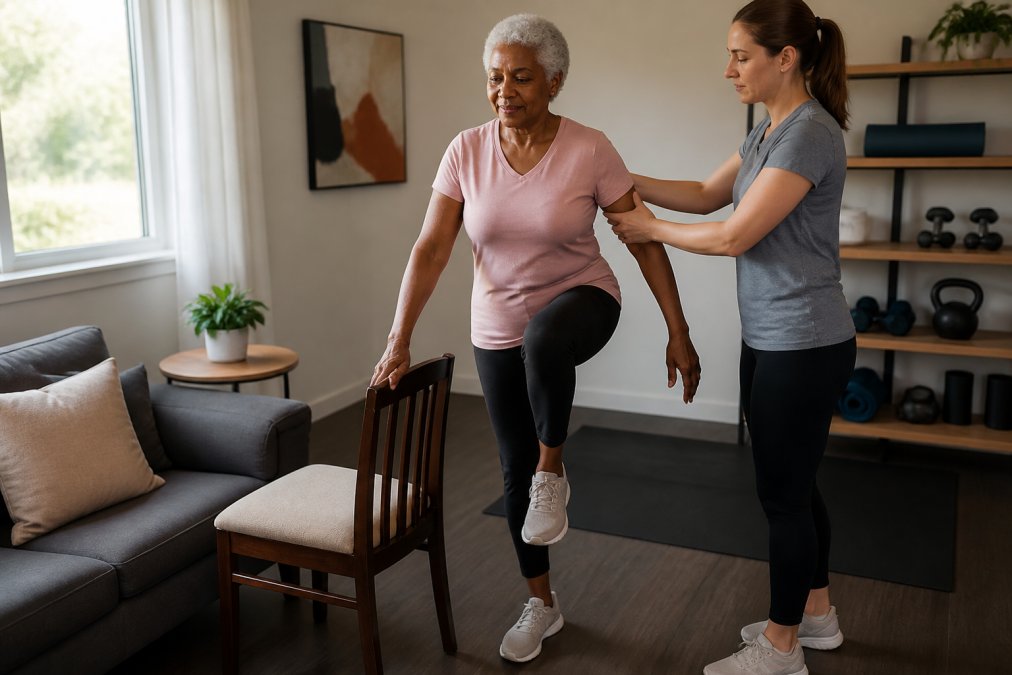
Sit-to-Stand and Single-Leg Stands
The sit-to-stand is the most practical strength move you can do. It mirrors getting out of a car, a chair, or a low couch.
- Sit toward the front of the chair, feet flat
- Lean forward slightly, then stand without using your hands
- Lower yourself back down with control
- Do 8 to 12 reps
Heel-to-Toe Walking and Standing March
Heel-to-toe walking, also called tandem walking, sharpens dynamic balance. Place one heel directly in front of the other toe and walk a straight line. Take 10 slow steps, turn, and come back.
A Progression Path, Not a Static List
Most exercise lists hand you the same moves forever. A better approach is to make each move slightly harder as it gets easy. Here is one path:
- Beginner. Both hands on a counter. Full support, slow tempo, short holds.
- Intermediate. One fingertip on the counter, or both hands hovering just above it. Longer holds, eyes open.
- Advanced. No hands, feet closer together, or eyes closed for a few seconds on the single-leg stand. Add a slow head turn during the march.
How Often, and How Long
A common pattern that works well:
- Strength work (sit-to-stand, chair plank): two or three days a week, with a rest day between sessions
- Balance practice (single-leg stands, tandem walking, marching): most days, in short bouts
- Session length: 10 to 20 minutes is plenty. Five focused minutes most days beats one long session a week.
When Fear of Falling Gets in the Way
A few things that help:
- Start where you are confident. If standing balance feels scary, begin seated. Confidence is built from evidence, and evidence comes from practice.
- Use support without apology. A counter, a wall, or a trainer’s hand is a tool, not a crutch. You can remove it later.
- Practice the recovery, not just the fall. Learning how to lower yourself safely to the floor and get back up reduces the fear of what happens if you do fall.
- Name the fear out loud. Telling a trainer, doctor, or family member what worries you makes it easier to work around.
- Track small wins. Standing for 15 seconds instead of 10 is progress worth noticing.
Static balance keeps you still. Dynamic balance keeps you moving. Train both, because daily life asks for both. And train the mental side too, confidence is a balance skill.
If fear of falling has kept you from exercising, one-on-one coaching is often the better starting point. A trainer can stand beside you, adjust each move to your comfort level, and build difficulty only as your confidence grows. That is the kind of work we do at our private studio, and it is why beginners often do better with a coach before joining any group setting.
Step 3: Add Lower Body Mobility Drills
Mobility drills keep your hips, knees, and ankles moving through their full range of motion. Stiff ankles alone can throw off your gait and posture.
- Ankle circles. Lift one foot and draw slow circles. Do 10 each direction, each foot.
- Sit-to-stand with a pause. Stand halfway, hold for two seconds, then finish. Do 6 reps.
- Gentle hip flexor stretch. Step one foot back, keep both heels down, and hold 20 seconds per side.
The Benefits of Personal Training for Seniors
The benefits of personal training for seniors come down to one thing: a plan built for your body, not a generic video.
Common Mistakes That Slow Your Progress
Watch for these:
- Holding your breath during effort
- Skipping the warm-up
- Practicing only on one side
- Pushing through pain instead of stopping
- Quitting after a few weeks
Start with movements you can do confidently, then add difficulty in small steps. Confidence grows from evidence, and evidence comes from practice.
Two more habits support your muscles: eat enough protein and drink enough water. Muscle needs both to rebuild. The USDA’s Dietary Guidelines for Americans offer plain guidance on both.
Frequently Asked Questions
How can a 70 year old improve their balance?
Start with supported moves you can do daily: sit-to-stands from a firm chair, single-leg stands while holding a counter, and heel-to-toe walking along a hallway. Pair these with core strength training for older adults, since a stable trunk gives your legs a solid base. Aim for short sessions several times a week rather than one long session, and increase difficulty gradually as each movement feels controlled.
What role does core strength play in preventing falls?
Your core keeps your trunk steady while your legs and feet adjust to changes in the ground beneath you. When core endurance drops, small wobbles turn into bigger losses of balance. Exercises that train the trunk to hold position, such as standing marches and slow bird-dogs, support posture and coordination during everyday tasks like reaching, turning, and stepping off a curb.
When should a senior consider professional personal training for balance?
Personal training is often the better starting point if you have fallen before, feel unsteady on stairs, or haven’t exercised in years. A trainer can check your form, adjust intensity to your level, and build a plan around your specific limits. A fitness consultation at a private studio lets you ask questions and see whether the approach fits before committing.
How long should a senior be able to balance on one leg?
Many healthy adults over 60 can hold a single-leg stand for about 10 seconds, though the number varies widely with fitness, prior injuries, and joint health. Treat it as a personal baseline rather than a pass-fail test. Time yourself monthly on each side while holding a counter for safety, and look for steady improvement rather than comparing yourself to a fixed standard.